
The jawline is one of the first places aging shows its hand. A face that once had a clean line from ear to chin starts to soften along the lower cheeks, and small pockets of skin begin to settle just past the corners of the mouth. Those pockets are jowls, and they have a way of making a person look older or more tired than they feel. The usual fixes rarely touch them. Skincare works on the surface, and losing weight can even leave loose skin looking slacker. So the question that brings most people to a med spa is a practical one. Is there a way to lift the jawline back into shape without booking a surgical facelift?
PDO threads are one of the more direct answers to that question. A PDO thread lift is a minimally invasive treatment that uses dissolvable surgical threads to reposition sagging tissue and rebuild the skin’s underlying support along the jaw and lower face. It delivers a visible lift the same day it is done, and it keeps working for months afterward as the body lays down fresh collagen around the threads. This guide covers what causes jowls in the first place, how the threads correct them, what the research supports, and how to judge whether the treatment fits your goals.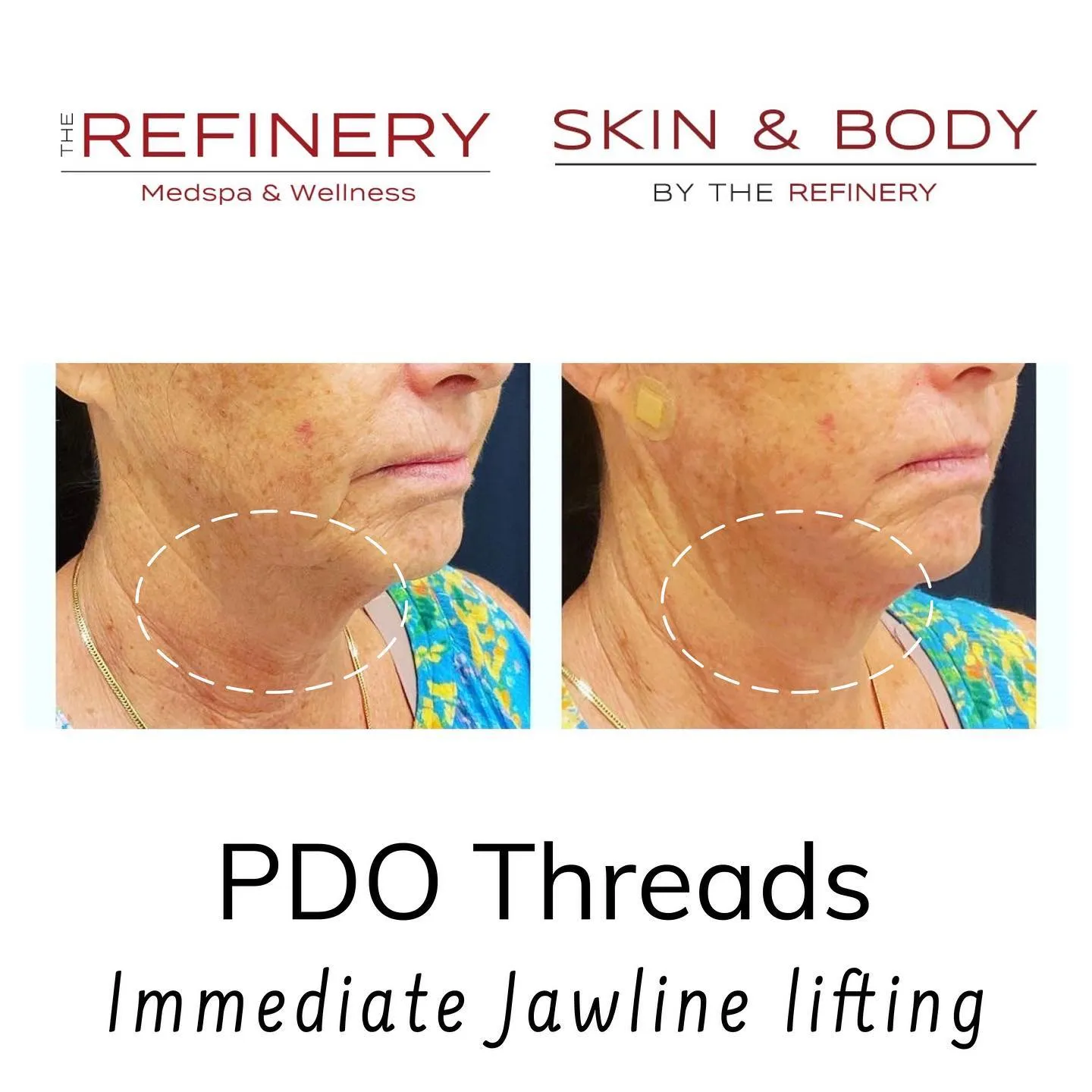
What Causes Jowls and a Softening Jawline?
Jowls form through a slow loss of structure. The skin, fat, and connective tissue that hold the lower face in place gradually give way, and gravity pulls the softened tissue downward until it gathers along the jaw. Collagen sits at the center of that process. It is the protein that keeps skin firm and springy, and the body makes less of it every year past a person’s mid-twenties. As the collagen scaffolding thins, skin loses its ability to snap back, and the fat pads that once sat high in the cheek slide lower.
Florida living can speed the timeline. Years of sun exposure break down collagen and elastin faster than they would otherwise, which is why sagging often shows up earlier and more sharply in people who have spent a lot of time outdoors. Genetics, weight fluctuations, everyday habits, and the natural drop in estrogen around menopause all feed into it as well. The result is the same regardless of the cause: a jawline that reads as heavier and less defined than it used to. You can read more about how these signs of facial aging develop and the ways they can be addressed.
How Do PDO Threads Lift Jowls and Define the Jawline?
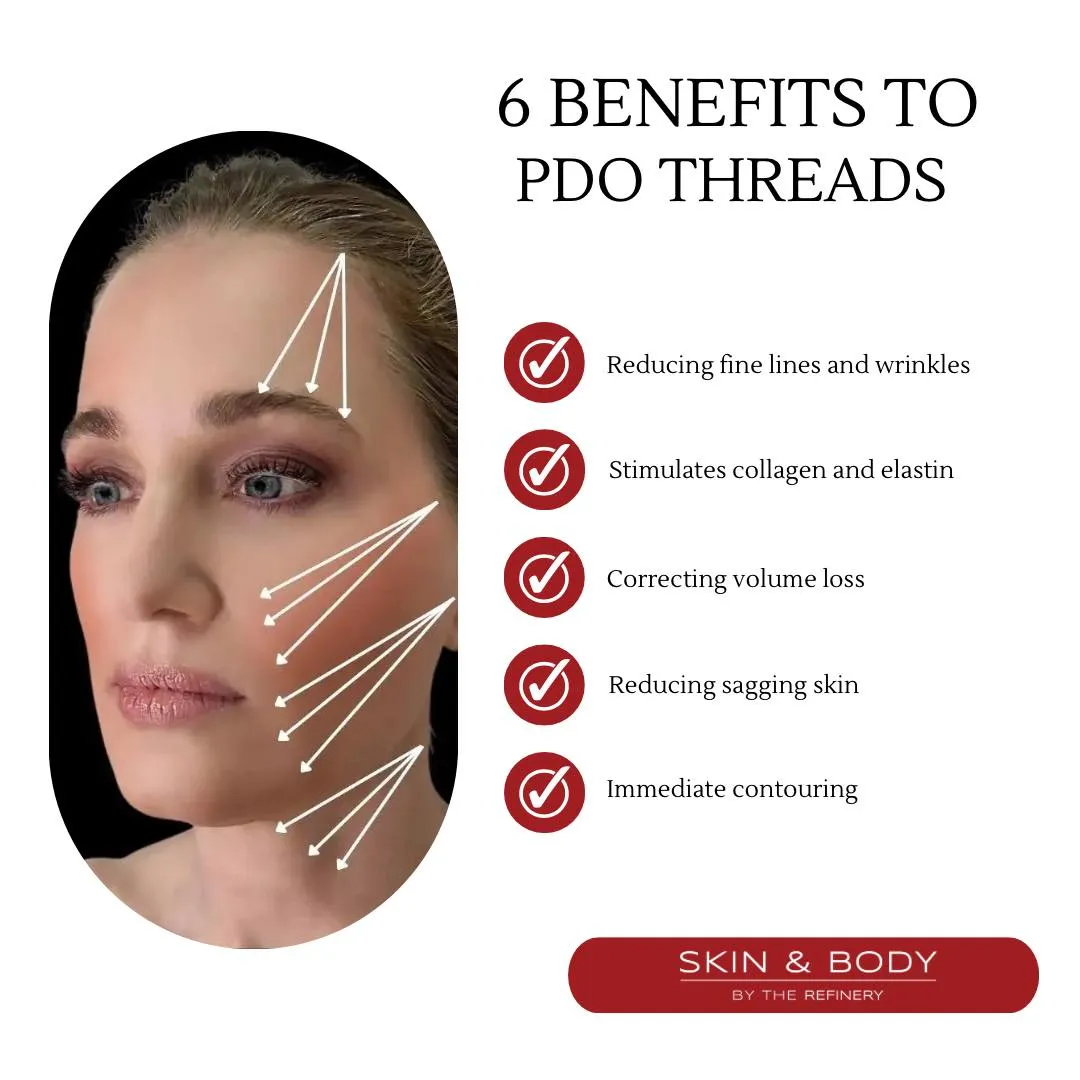
A PDO thread lift works on two timelines at once. PDO stands for polydioxanone, a bio-absorbable material that surgeons have relied on to close incisions for decades. The threads are studded with tiny barbs molded into the strand, and a provider inserts them under the skin through a thin cannula, with no cutting involved. As a thread passes through the tissue, the barbs catch and grip the sagging fat and skin, and when the provider draws them into position, the lower face is physically lifted and the jawline is redrawn. That is the immediate effect, and it shows the moment the appointment ends.
The second timeline is where the lasting result comes from. The body treats each thread as something to heal around, so it responds by producing new collagen along the length of the strand. Over the weeks that follow, that fresh collagen forms a web of support that holds the lifted tissue in place. The threads themselves dissolve over roughly six months to a year through a natural process, and by the time they are gone, the collagen network has taken over the job of holding the contour. At The Refinery, a PDO thread lift in West Melbourne, FL is placed in a grid pattern mapped to the areas that need the most support, whether that is the jawline itself or the cheeks and folds above it.
What Does the Research Show?
Thread lifting has a growing base of measured evidence behind it, and some of the clearest data looks specifically at the jawline. In a peer-reviewed pilot study that used three-dimensional photography to track outcomes, the distance from the ear to the jowl improved by an average of about 5.5 millimeters right after treatment and still held near 4 millimeters at the roughly eight-month follow-up. That kind of number matters because it captures the lift objectively rather than as a before-and-after impression, and it shows that a meaningful share of the correction lasts well past the first few weeks.
How Do PDO Threads Compare to Other Jawline Treatments?
No single treatment fixes every kind of jawline concern, and the right choice depends on what is actually driving the change. Loose, descending skin needs a lift, which is what threads provide. Lost volume calls for filler. A jaw made heavy by an overactive chewing muscle calls instead for softening that muscle. The table below lays out how PDO threads sit next to the other options The Refinery offers for the lower face.
| Treatment | Best for | How long it lasts | Downtime |
|---|---|---|---|
| PDO thread lift | Mild to moderate sagging along the jaw and jowls | About 12 to 18 months, aided by new collagen | Minimal, with possible tenderness for a few days |
| Dermal fillers | Lost volume and softening at the jaw angle | Roughly 12 to 18 months by product | Minimal, occasional bruising |
| Botox / Dysport | A wide jaw from an enlarged chewing muscle | 3 to 4 months per treatment | None |
| Kybella | A double chin caused by fat under the jaw | Permanent fat reduction once treated | Swelling for one to two weeks |
| Surgical facelift | Advanced, heavy sagging of face and neck | Many years | Several weeks of recovery |
Many people get their best result from a combination rather than a single treatment. Threads handle the lift, while a volumizing filler such as Radiesse for jawline definition in West Melbourne can rebuild a sharp angle at the back of the jaw. If a soft chin is more about fullness underneath than loose skin, Kybella to reduce a double chin in Indian Harbour Beach targets that fat directly. And when a heavy jaw traces back to an overworked masseter muscle instead of sagging, our guide to Botox for a slimmer, more defined jawline explains how relaxing that muscle narrows the lower face.
What Results Can You Expect, and When?
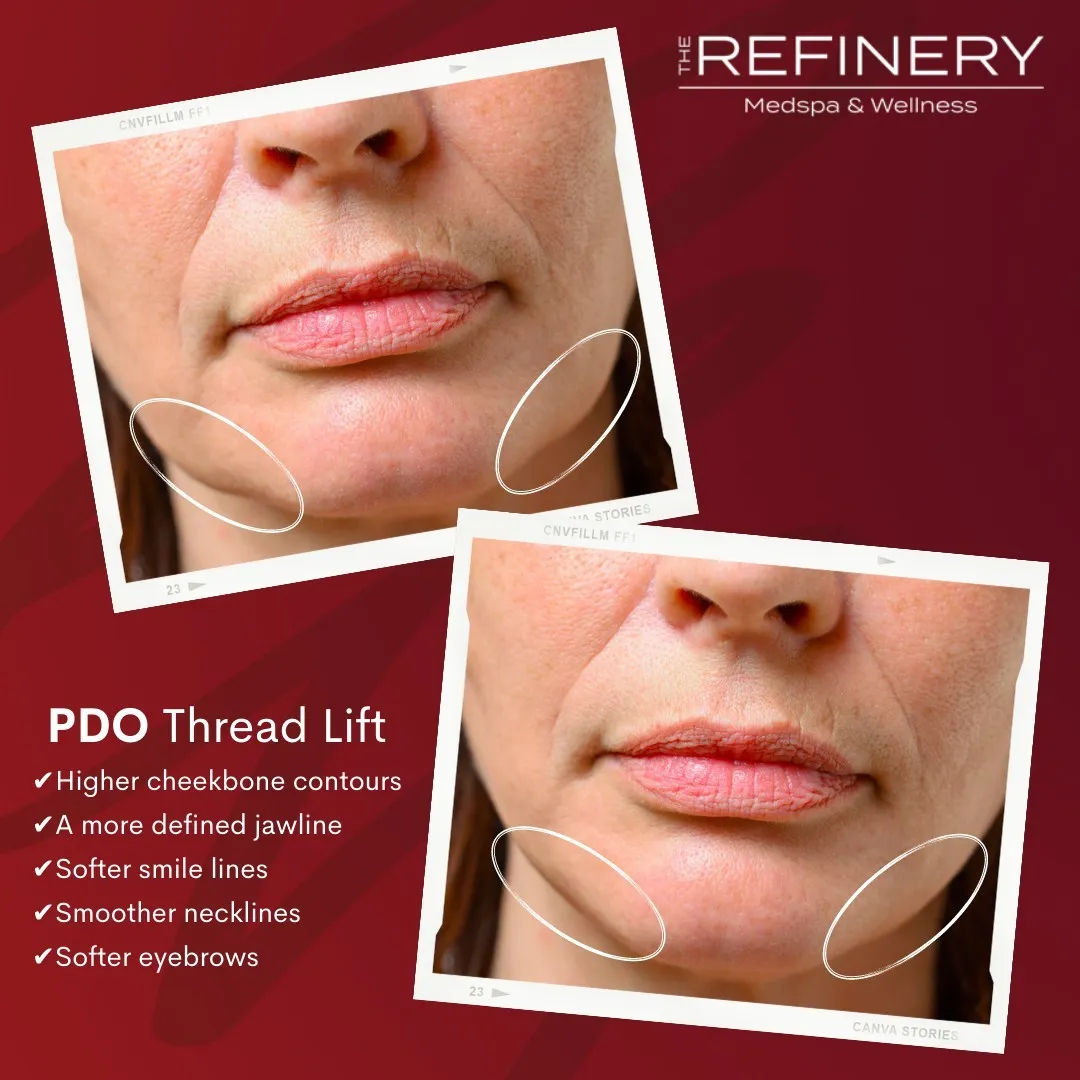
Part of the appeal of a thread lift is that you walk out of the appointment already looking lifted. The threads hold the tissue in its new position right away, so the jawline looks cleaner and the jowls look softer before you leave. That first result settles over the following days as any minor swelling fades, and the line often looks even more natural a week or two later than it did on day one.
The longer-term payoff arrives on collagen’s schedule. Over the two to three months after treatment, new collagen builds around the threads and firms the skin from within, which can improve texture and tighten the area beyond the mechanical lift. Most people find the full effect holds for somewhere between a year and 18 months, though this varies with age and skin quality and with how much sagging was present to begin with.
| What to expect from your results
A PDO thread lift gives an immediate lift to the jawline and jowls, and the collagen your body builds around the threads extends that result well past the point when the threads dissolve. It refines and firms the lower face rather than reversing every sign of aging. Protecting your skin from sun and holding a steady weight both help the result last. |
 Who Is a Good Candidate for a PDO Thread Lift?
The treatment suits adults with mild to moderate sagging along the jaw and lower face who want a real improvement without the recovery a facelift demands. Skin quality matters as much as age. The best candidates have enough skin thickness for the threads to anchor well, and they are looking to refine a jawline that has started to soften rather than to correct a heavy, deeply sagging neck. A provider assesses this in person, because the same treatment that looks excellent on one face can be the wrong tool for another.
A thread lift tends to be the strongest fit in two situations:
- You are in your late thirties to fifties and have noticed early jowls or a softening jawline that skincare and weight management have not improved.
- You want a visible lift with little downtime and are not ready, or not willing, to commit to surgery.
For someone with advanced skin laxity or significant loose skin on the neck, a surgical consultation is often the more honest recommendation, and a good provider will say so. When the concern is skin texture and mild tightening rather than a true lift, a treatment like radiofrequency skin tightening may suit the goal better on its own or alongside threads.
What Does the Procedure Feel Like, and Is There Downtime?
A thread lift is an in-office treatment that usually takes 45 to 90 minutes. The provider numbs the treatment area with local anesthesia first, so the placement itself registers as pressure and movement more than pain. Once the area is numb, the threads go in through a fine cannula, and the provider adjusts the tension to shape the jawline before trimming the ends below the skin.
Recovery is light. Most people head back to their normal routine the same day, with some tenderness or mild swelling for a few days that over-the-counter pain relief handles easily. Providers generally advise easing off heavy exercise and sleeping face-down for a week or two, and holding back on wide mouth movements such as big yawns while the threads settle. Any small dimpling at the entry points typically smooths out within days.
How Do You Maintain Your Results?
The single biggest factor in how long a thread lift lasts is how well you protect your skin from further collagen loss. Daily sunscreen slows the sun damage that ages a Florida jawline faster than almost anything else. A stable weight keeps the lifted tissue from shifting, since large swings can stretch or slacken the skin the threads are supporting. Many people schedule a touch-up as the first set of threads dissolves, which stacks a fresh round of collagen stimulation on top of what the initial treatment built.
Good skincare supports the result between treatments. Products with retinoids and peptides encourage collagen on their own, and in-office treatments that build collagen, such as microneedling, pair well with threads over the long run.
Common Questions About PDO Thread Lifts
Does a thread lift hurt?
The local anesthesia does most of the work of keeping you comfortable. After it takes effect, the placement feels like tugging and pressure rather than sharp pain. Some tenderness in the days afterward is normal and usually mild.
How long do PDO threads last?
The threads themselves dissolve over about six months to a year, but the result outlasts them because of the collagen your body builds along the way. Most people enjoy the effect for 12 to 18 months before considering a touch-up.
When will I see results?
Right away. The lift is visible as soon as the threads are placed, then it refines over the next week or two as swelling settles, and the skin keeps firming over the following two to three months as collagen develops.
Can a thread lift be combined with other treatments?
Yes, and it often is. Threads pair naturally with dermal fillers for lost volume and with collagen-building treatments like microneedling, and they work alongside neuromodulators when an overactive muscle is part of the picture. A provider can map out a plan that layers these to fit your goals and budget.
PDO Thread Lifts at The Refinery in West Melbourne and Indian Harbour Beach
If a softening jawline or the first hint of jowls has you weighing your options, the next step is a conversation with a provider who can assess your skin and tell you honestly whether threads are the right fit. The Refinery Medspa & Wellness offers PDO thread lifts across the greater Melbourne, Viera, and Palm Bay area. Our West Melbourne office sits at 4311 Norfolk Pkwy #114, West Melbourne, FL 32904, and can be reached at 321-341-3321. Our Beachside location at 2194 Jimmy Buffett Mem Hwy, Unit 104, Indian Harbour Beach, FL 32937 can be reached at 321-339-2633. We also offer payment plans to spread the cost of a treatment plan, and you can book a complimentary consultation to find out what a lift could do for your jawline.
References
Diaspro A, Luni M, Rossini G. Thread Lifting of the Jawline: A Pilot Study for Quantitative Evaluation. Journal of Cutaneous and Aesthetic Surgery. 2021;14(1):47-54. https://pubmed.ncbi.nlm.nih.gov/34084008/
Wanitphakdeedecha R, Yan C, Ng JNC, Fundarò S. Absorbable Barbed Threads for Lower Facial Soft-Tissue Repositioning in Asians. Dermatology and Therapy. 2021;11(4):1395-1408. https://pmc.ncbi.nlm.nih.gov/articles/PMC8322220/
Contreras R, et al. Using PDO Threads: A Scarcely Studied Rejuvenation Technique. Case Report and Systematic Review. Journal of Cosmetic Dermatology. 2023. https://onlinelibrary.wiley.com/doi/10.1111/jocd.15709